When Spotify launched, the music industry was in a piracy-induced freefall. Today, it is the largest driver of industry revenue growth, paying out billions to rights holders while serving hundreds of millions of users.
But how does a company that lets millions of people listen to music for free actually generate revenue? The answer lies in a masterclass of the "freemium" business model, data monetization, and massive scale.
The Freemium Engine
Spotify operates on a two-sided marketplace, relying on a funnel that attracts massive audiences with a free product and slowly converts a portion of them into paying subscribers.
1. Premium Subscriptions (The Heavy Lifter)
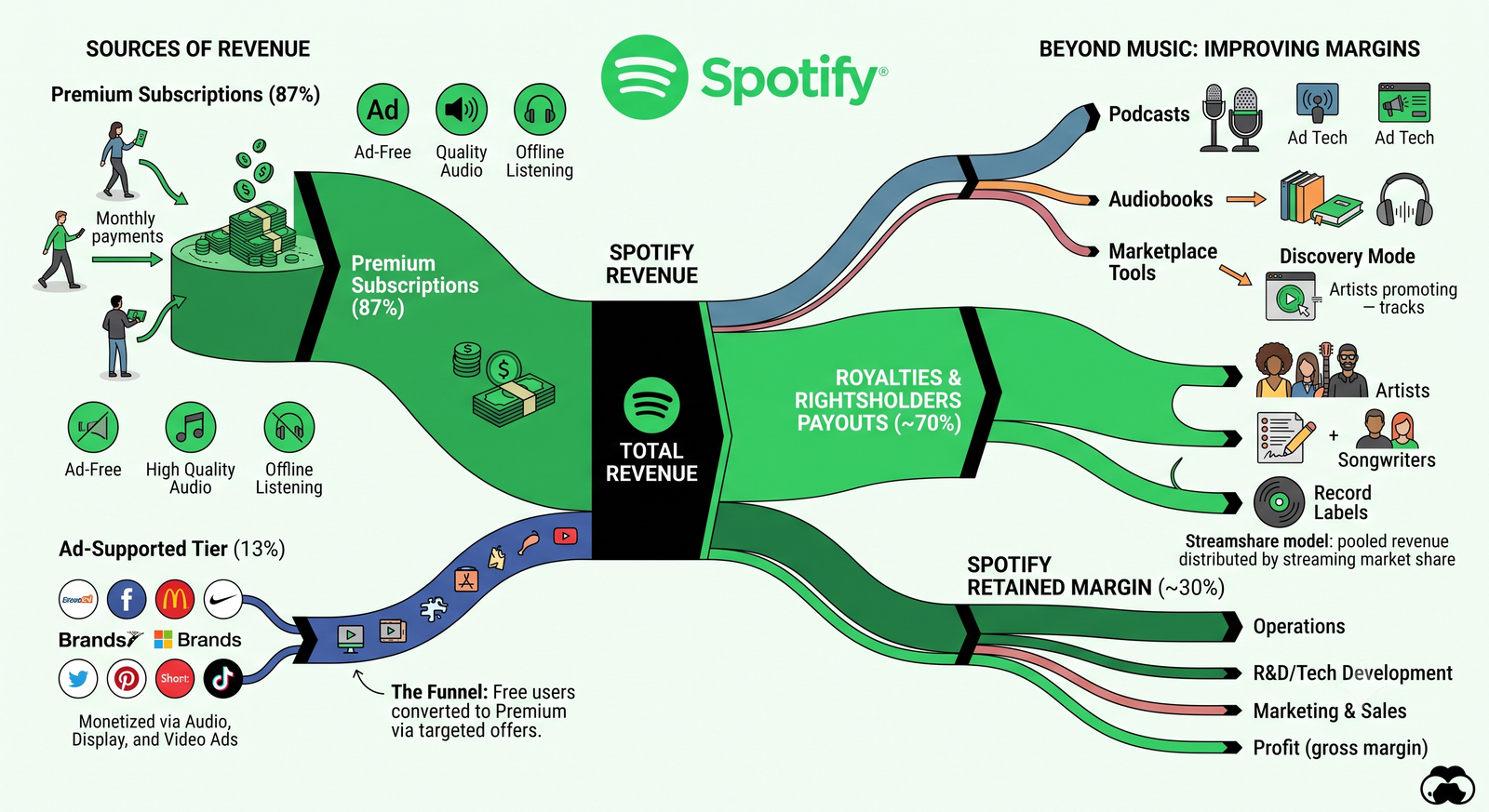
This is the economic core of the company. Premium subscriptions account for roughly 87% of Spotify's total revenue (generating over €11.5 billion in recent fiscal years). Users pay a recurring monthly fee for an ad-free experience, high-quality audio, and offline listening.
To maximize conversion across different demographics, Spotify offers multiple entry points:
- Individual: The standard single-user plan.
- Duo & Family: Discounted bundles for households, which drastically lower the "churn" (cancellation) rate.
- Student: A deeply discounted tier to capture younger listeners early and build long-term brand loyalty.
2. Ad-Supported Tier (The Funnel)
While the free tier brings in the vast majority of users, it generates a much smaller slice of the pie — roughly 12-13% of total revenue. Free users "pay" with their attention. Spotify monetizes this audience by selling audio, display, and video ad inventory to brands.
More importantly, the free tier acts as a massive, low-cost customer acquisition tool. By tracking listening habits, Spotify uses data to perfectly time promotional offers, nudging free users toward Premium.
| Feature | Ad-Supported (Free) | Premium |
|---|---|---|
| Revenue Source | Advertisers | Monthly Subscriptions |
| Audio Quality | Standard (up to 160 kbps) | High (up to 320 kbps) |
| Playback | Shuffle-only on mobile | On-demand control |
| Listening | Intermittent ads | Ad-free, offline downloads |
Beyond Music: Expanding the Wallet
Because roughly 70% of music revenue is immediately paid out in royalties, Spotify has aggressively expanded into formats with better profit margins.
- Podcasts: Spotify spent heavily to acquire exclusive podcasts and ad-tech platforms. Because podcast deals are negotiated differently than music licenses, Spotify keeps a much larger share of the advertising revenue generated during these shows.
- Audiobooks: By offering a block of free audiobook listening time to Premium subscribers, Spotify increases the perceived value of the subscription, aiming to reduce churn and justify future price hikes.
- Marketplace Tools: Spotify also monetizes the artists themselves. Through tools like "Discovery Mode," artists and labels can accept a slightly lower royalty rate in exchange for an algorithmic boost to help their tracks reach new listeners.
The Royalty Reality
A common misconception is that Spotify pays a flat rate per stream (e.g., $0.004 per play). In reality, Spotify uses a "streamshare" model.
Every month, Spotify pools the total revenue generated in a specific market. It then calculates what percentage of total streams belonged to a specific artist. If an artist's tracks account for 1% of all streams in the US, their rights holders receive 1% of the US royalty pool.
From there, the money goes to record labels and distributors, who then pay the artists based on their individual contracts. While the model has completely revived the music industry's bottom line — paying out over $11 billion in a single year — the sheer volume of artists on the platform means that massive payouts remain heavily concentrated at the top.